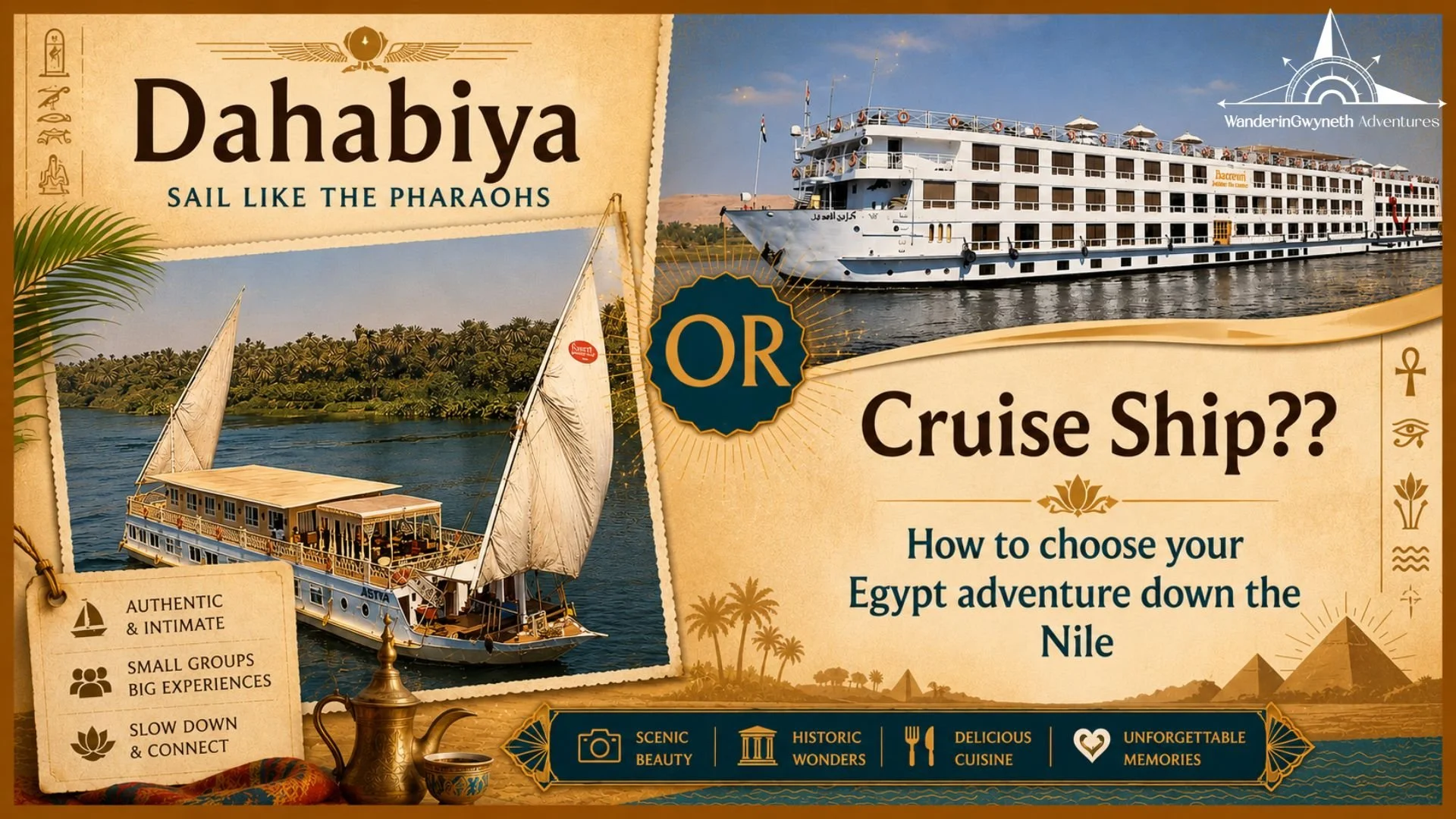
How do you choose between a dahabiya (small sailing ship) and a cruise ship when planning your trip to Egypt? Often times we just look at price, but you need to know exactly why and what you are choosing for your cruise down the Nile. This post is for all those adventurers, travel agents, and advisors who need and want to know how to choose the right fit for the specific traveler.
What Is a Dahabiya? (And What Is a Nile Cruise Ship?)
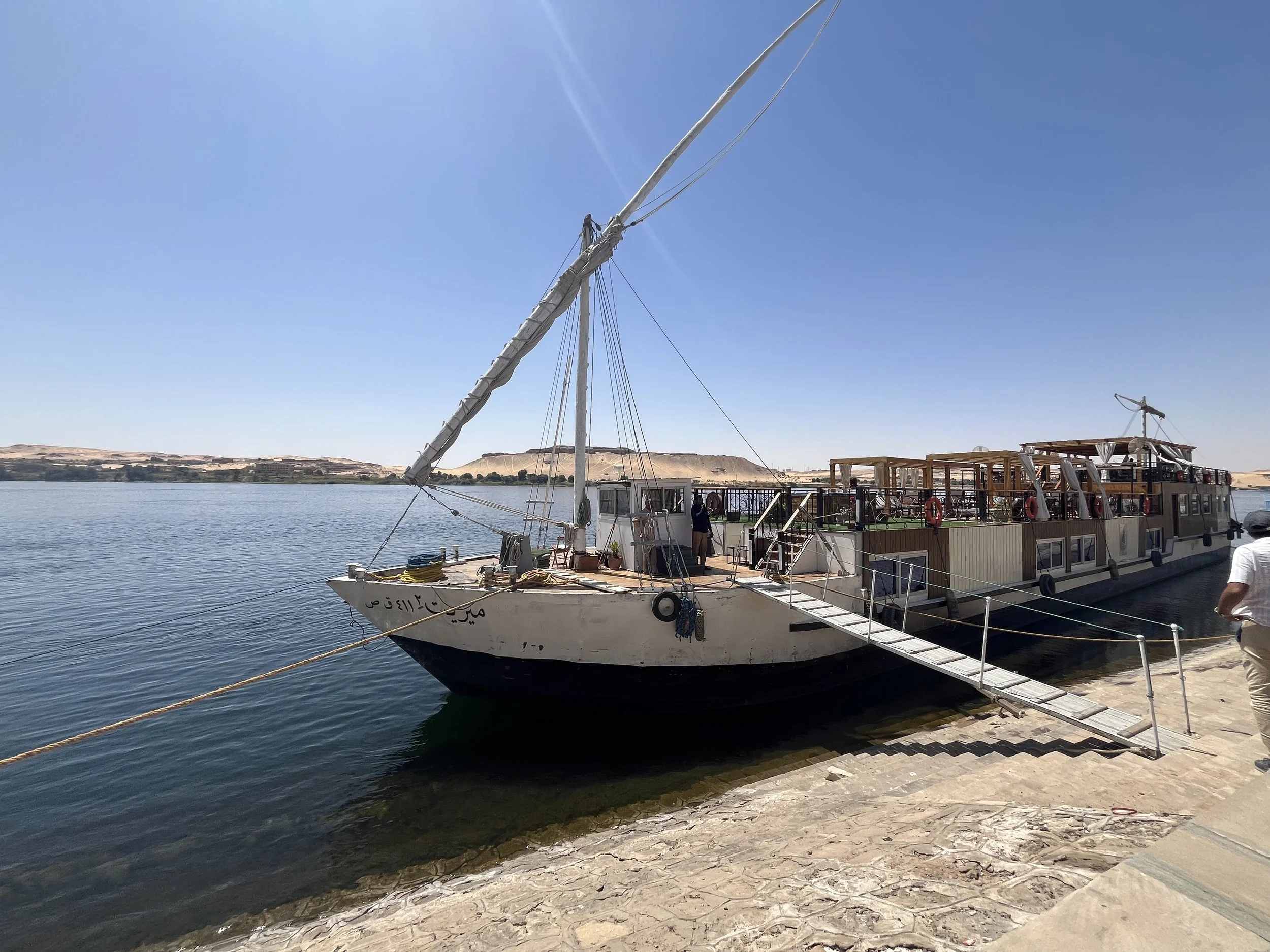
A dahabiya usually only has 2 decks. A sundeck partially covered for meals and gathering and the living quarters. Photo by author.
A dahabiya (dahabeya/dahabiyya) is a smaller, wind-powered (supposedly, but not exclusively) sailing vessel that takes 8-24 guests (4-12 cabins) up and down the Nile. It is recognized by usually having two sails and is typically accompanied by a tugboat.
Known for its slower pace on the Nile, it has often been extolled as the most luxurious way to experience the Nile.
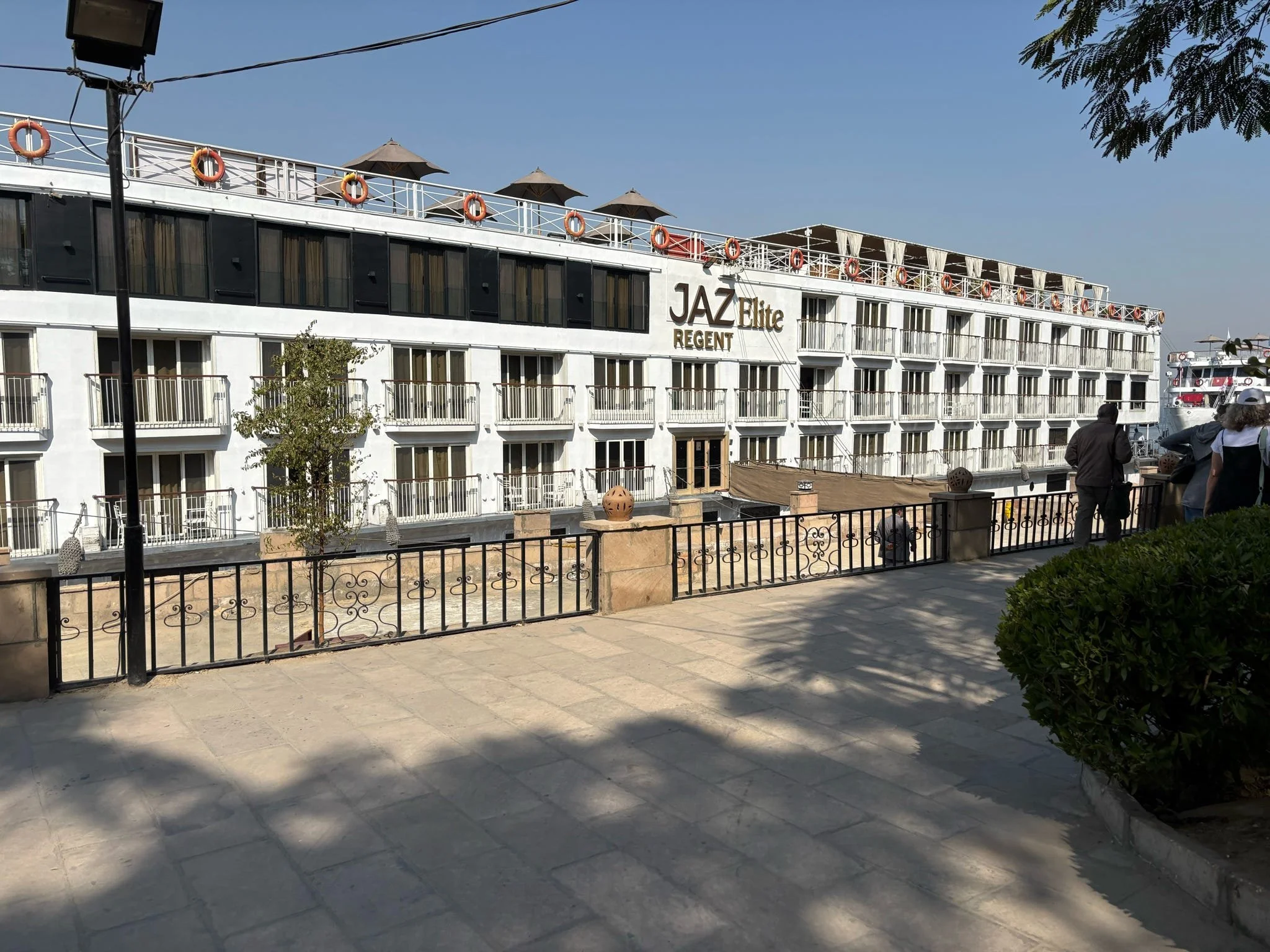
Cruise ships typically have 4 decks plus a sundeck. The Jaz Elite Regent is a 5-star luxury cruise that I’ve sailed on most frequently. The crew and the service is top notch. Photo by author.
A cruise ship has anywhere from 25-75 cabins with 50-150+ guests. It is larger, motor-powered sailing vessel. It often has amenities such as a dining room, pool, gym/fitness area, meeting room, and typically houses a jewelry shop and a clothing shop.
Atmosphere & Pace
I’ve been on my fair share of cruise ships and dahabiyas on the Nile, and there is a time and a place for each. The atmospheres are different and you have to think about what you want out of your time on the Nile.
| Feature | Dahabiya | Cruise ship |
|---|---|---|
| Capacity | 4–10 cabins, 8–20 guests | 25–75 cabins, 50–150 guests |
| Atmosphere | Quiet, wind-powered sailing; intimate | Lively and social; constant engine hum |
| Amenities | Sundeck, lounge, simple comforts | Pool, spa, gym, bars, entertainment |
| Itinerary access | Secluded islands and quiet moorings | Major ports and busy docks only |
| Service | Personal, tailored to each guest | Professional but standardized |
| Pace | Slow, unhurried, flexible | Fixed, fast-moving schedule |
| Eco-footprint | Low; wind-powered, few guests | Higher; engine-driven, high volume |
| Price | Higher per night; boutique value | Lower per night; more for less |
| Best for | Calm, cultural, crowd-free travel | Amenities, activities, and budget |
A dahabiya, with its romantic vibe, offers a chance to see the Nile up close, with several stops along the banks. Many dahabiyas offer a slow-travel, luxury feel. If you want to feel like you are embarking on an Agatha Christie novel, this is for you. Because the boat is smaller, often you get a more intimate experience. Guests typically dine on deck and enjoy down time in their cabins or on deck when it isn’t mealtime. Dahabiyas sometimes offer small pools or hot tubs. The service on these trips is very good, because the crew gets to know you quickly and anticipates your needs. The name of the game is to relax and enjoy. For me, the best times spent on the Nile were reading on the deck and watching the sunset. Some dahabiyas also have a more leisurely pace with little excursions where the big ships can’t go.
On windy days, the crew might open the sails, but here is the disappointing reality: No commercial dahabiyas use the wind exclusively to move up and down the Nile. If you had to wait for wind, it might take a week from Luxor to Aswan. Small tugboats accompany the dahabiya, ensuring that you reach your ports at the allotted time.
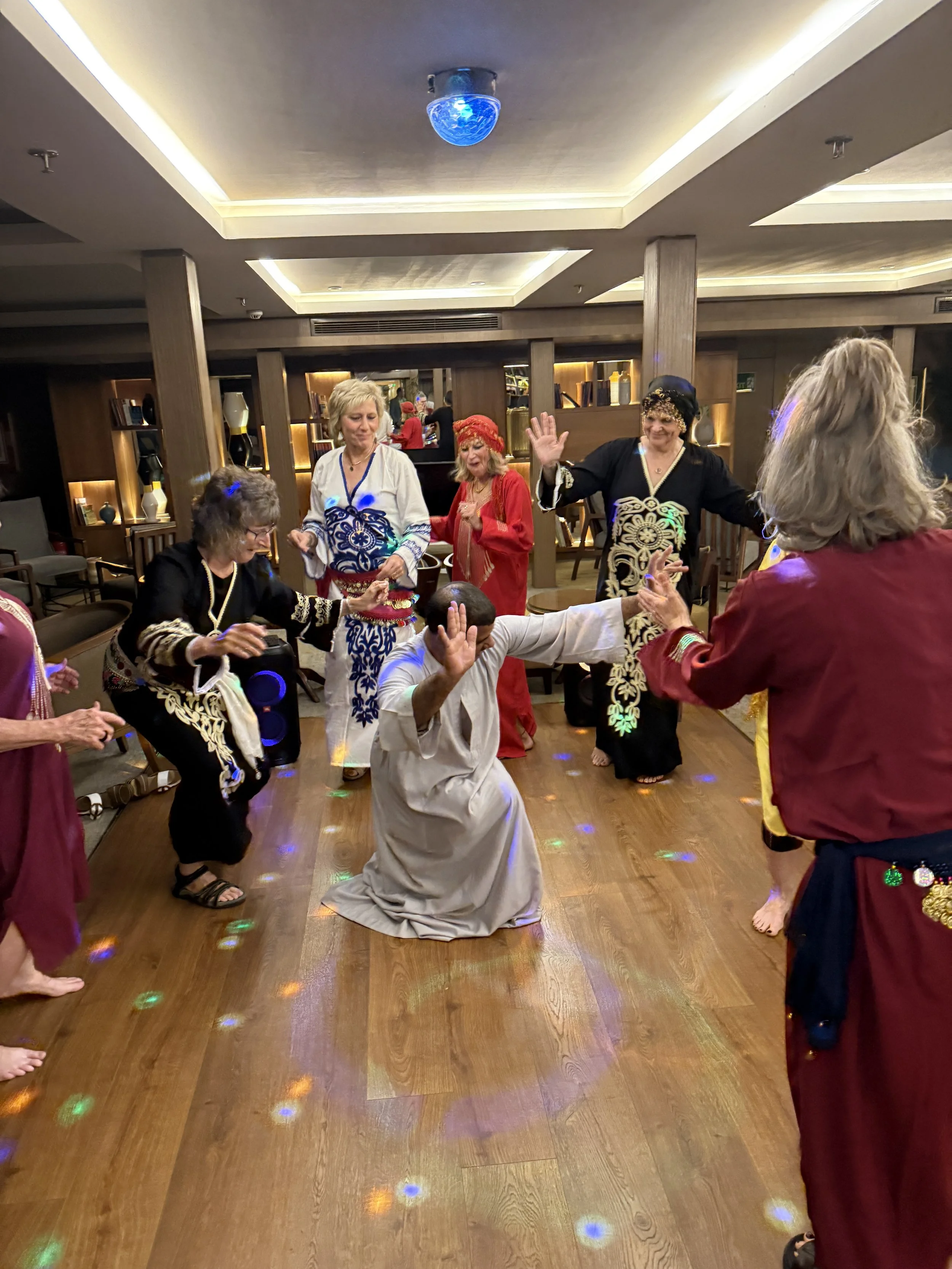
The gallabeya (traditional Egyptian dress) party is always a hit with tons of dancing and local music on the cruise ships. Photo by author.
A cruise ship offers a more convivial atmosphere. This is great if you are a family or friend group and want some party time. If you jump on a Jaz or Movenpick cruise ship, the crew is there to welcome you and set the mood. These are in essence floating-hotels, which offer great amenities. Every night typically has a theme, an oriental night with Egyptian cuisine and music, a Nubian night, a belly dancer and a tanoura (whirling dervish Egyptian-style) dancer. Because the stops are more routine, guests have more time to spend at the pool, getting a drink at the rooftop or lounge bar, or having a massage. You also have time to shop because most ships carry a silver and clothing vendor. This is a great time to commission a cartouche with your name on it and have the time to have it made to your specifications.
Cabins on the cruise ships are typically spacious with mini-bars, air conditioning, and options for Nile-view and upgrades. The higher on the ship, the more expensive the rate.
Dahabiyas usually offer only one level of cabin, and because of their mooring, often it switches which room gets a view what night. Cabins also have air conditioning, and might be smaller in size, but don’t let that deter you. Many ultra luxury dahabiyas have suites and amazing design on the interiors.
Breaking down another common misconception: When the boat or ship says they have Wi-Fi, it’s not true. Typically in the cities, you might get a decent signal if you have an Egyptian SIM card, but while you are sailing down the Nile, more often than not, the ship’s Wi-Fi will not be enough to send pictures over WhatsApp. It’s a messages only type of situation.
Where Each Can Take You: Itinerary & Mooring
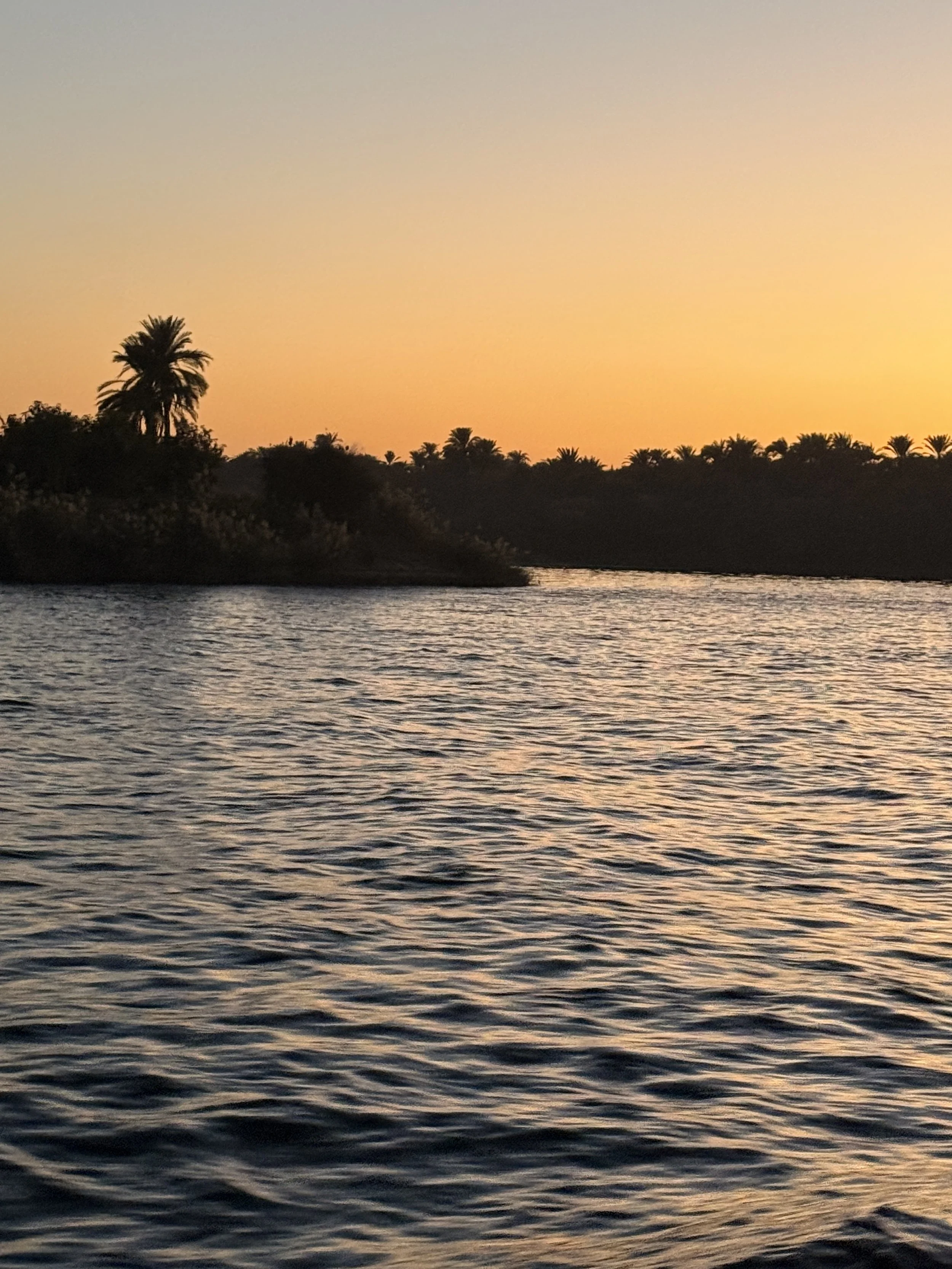
Regardless of whether you choose the dahabiya or cruise ship, you get to watch the sunset on these beautiful ancient waters. Photo by author.
If you are strapped for time, the larger cruise ships move efficiently down the Nile so that you can see all your sights with some downtime. There are many cruise ships to choose from, depending on what day you arrive and where you want to leave from – Luxor or Aswan – you will have MANY choices within your budget for a Nile cruise.
Each of the large ships can only dock at the large sites and typically ALL AT THE SAME TIME. You will disembark with all the other Nile cruisers to see the Temple of Horus in Edfu, Kom Ombo Temple in Aswan, and it’s debatable when and if you will experience going through the locks in Esna. Unfortunately, the Egyptian Tourism Authority has not figured out the importance of staggering the boats throughout the day, because you will literally crowd into the sites at the same time as the other ships.
The shallow-draft dahabiyas often stop on secluded islands and manage to arrive at the temples off the schedule of the big cruises, giving these small ships their biggest advantage. This little difference is worth the price differential because it gives you intimate time with the sites, allows for cultural excursions near Daraw and Besaw Islands and Jebel el-Silsila. Dahabiyas often take the time to let you float, swim, or paddle in the Nile and appreciate its timeless beauty. (Don’t worry they stop in places where the water is moving and safe).
Dahabiyas’ other big advantage is stopping in the city of Esna. Esna has the most colorful temples on this part of the Nile, and they have been amazingly well preserved. The city itself has gotten a facelift and some tourism training, making it a lovely starting or finishing point to any cruise. One thing to note about the dahabiyas is many of them start from Esna to avoid the locks. Check to see where you will need to board/disembark, depending on the dahabiya.
The cruise ships and the dahabiyas both offer full board, meaning all meals are included which is something to keep in mind when thinking about the price.
Practicalities? All cruises offer 3 nights, 4 days leaving from Aswan to Luxor (south to north or downriver). Luxor to Aswan is usually 4 nights, 5 days, which includes tours to Luxor sites.
Cost: Is a Dahabiya Worth It?
Yes. In my opinion, paying a little more for the dahabiya is completely worth the memories and experience, while dependent on budget and timing. Most of the dahabiyas that will come up in your searches will be the ultra-luxe styles of the rich and famous. I partner with a dahabiya company (Dahabiya Nile Sailing) that keeps costs down yet offers that amazing experience AND the luxury!
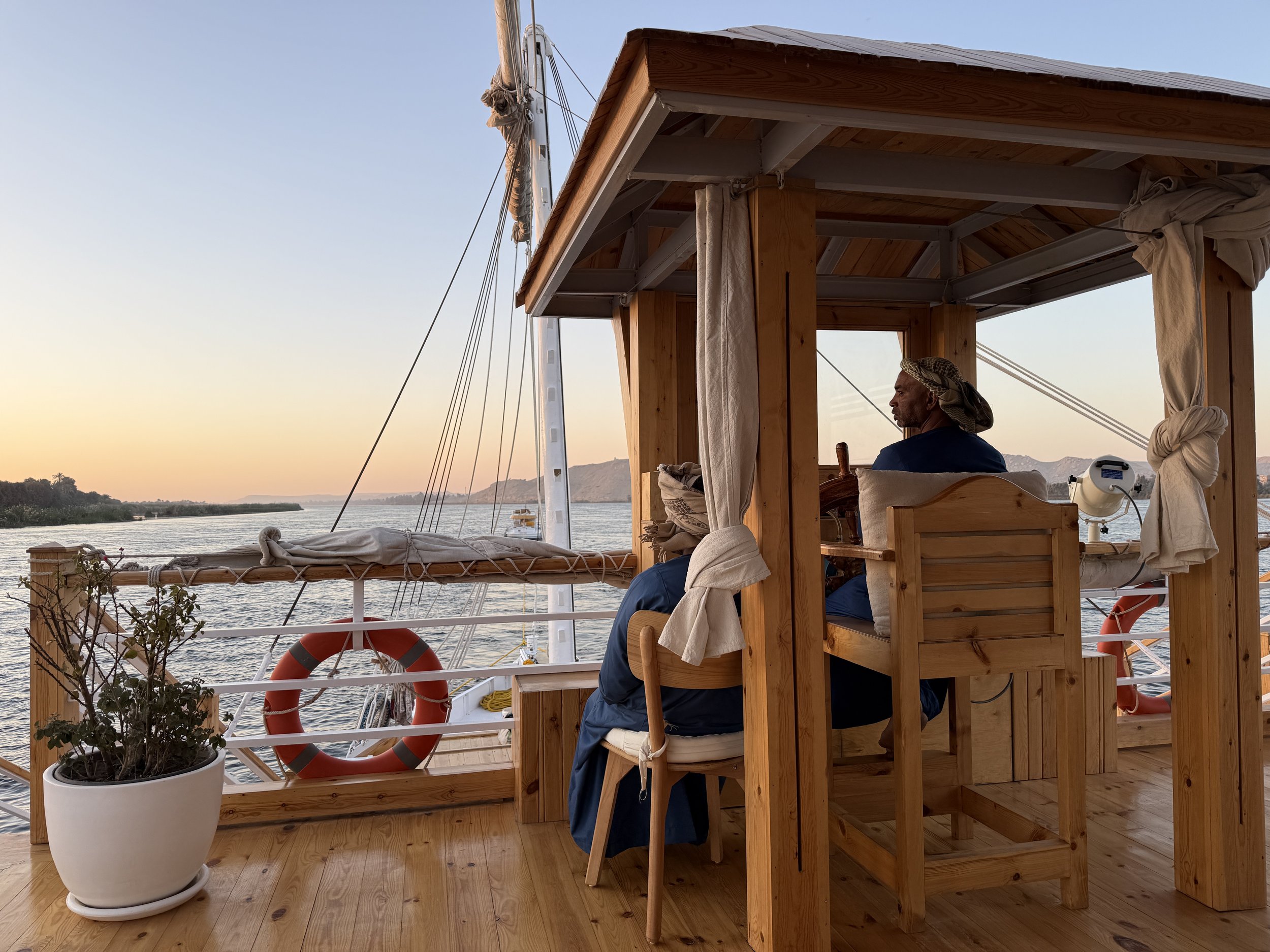
The Nubian boat pilots watch the sunset. Photo by author.
The cruise ships are plentiful and offer a better variety for budget and departures if you are strapped for time and cash. Many of these ships offer great value, so it’s hard to say “take this and not that.”
Eco-Footprint For the sustainability-minded friends out there, the eco-friendly choice is typically the dahabiyas, but not because they are wind-powered (remember - there is usually a tugboat to pull the dahabiya around). This is the biggest point of eco-friendliness there is. Unfortunately, a major pain point of the Egyptian tourism system is that trash is everywhere. Checking out each cruise ship (or the hotels that own them) and dahabiyas and their commitment to sustainability policy is probably where you will get greater details.
Which Should You Choose? The Bottom Line:
Choose a dahabiya if you want the romance, the extra in-depth cultural and historical stops, and intimacy of quieter stops at the temples. You will never regret it.
Choose a cruise ship if you are strapped for time and budget. Cruise ships are always sailing and sometimes you can get the better deal. Pay for an upgraded or Nile-view room and enjoy yourself.
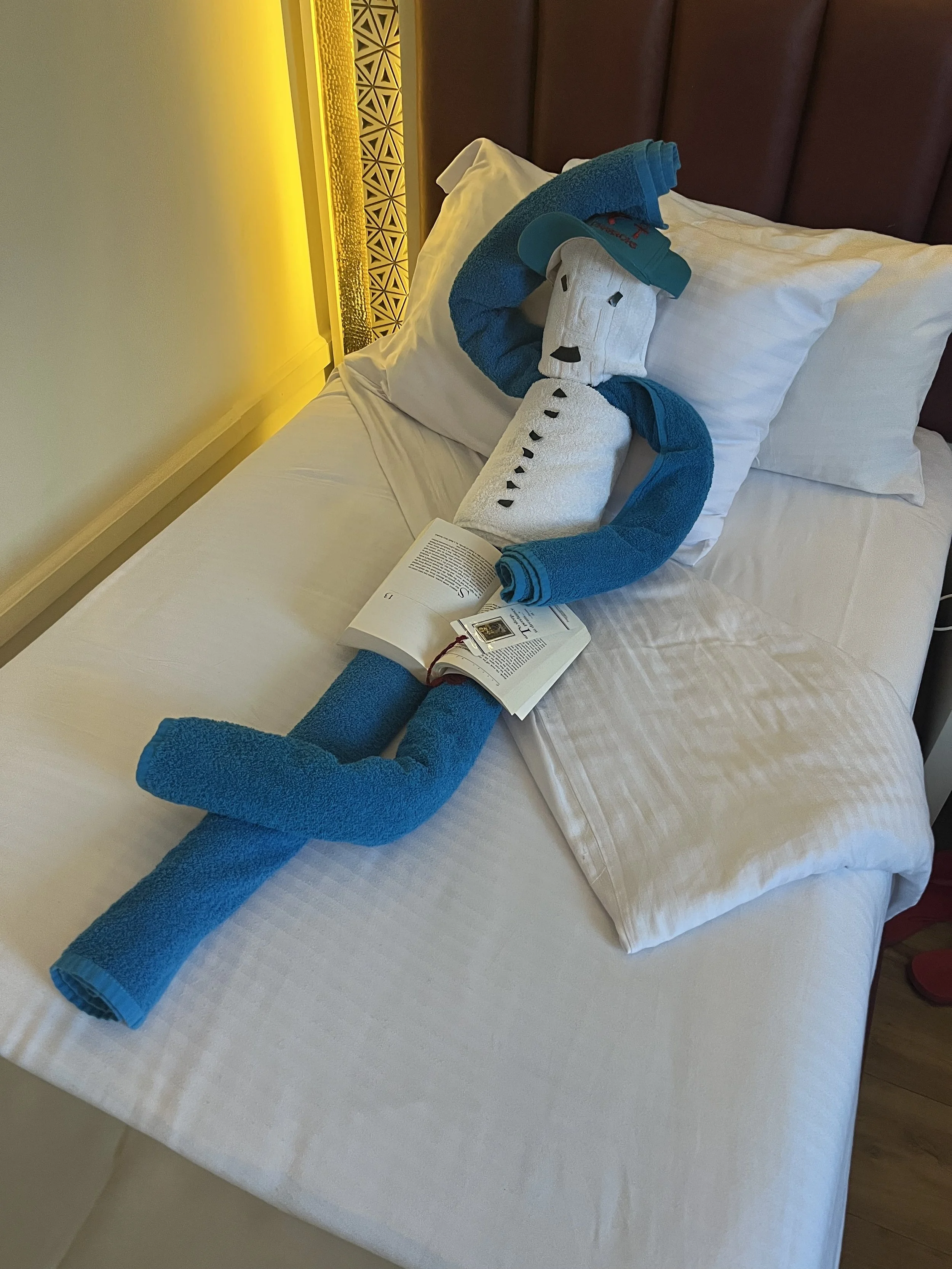
Towel art is a crew favorite to make you smile either in the dahabiya or the cruise ship. Photo by author.
Bonus: When is the best time to sail down the Nile?
The best time to book your Nile cruises is between November and March, yet there is a great sweet spot the 2nd and 3rd weeks of January where there is a lull in an otherwise high season. Cruises still run through the summer and yes, they can be cheaper, but keep in mind-you will pay with your sweat and risk heat exhaustion if you aren’t ready to deal with the 120F temperatures in the south during an Egyptian summer.
Go with WanderinGwyneth Adventures
If you have been imagining yourself on the legendary Nile soaking up every minute of culture and history, our small-group tours are for you. We only use dahabiyas on our Journey Down the Nile cruises, ensuring that you get to walk and sail in the footsteps of the pharaohs. If you are looking for itinerary or cruise ship suggestions and bookings, please reach out for the latest recommendations.